
Life Expectancy Rose to 80. Divorce Rates After 50 Tripled. Here's The Connection.
You know what nobody prepares you for? The moment you realize you might have twenty more good years left and you're spending them with someone who stopped knowing you somewhere around the Bush administration. (Either Bush. Take your pick.)
If you're 50, you've potentially got three decades ahead of you. That's not "twilight years." That's another entire adult lifetime. Life expectancy is pushing 80. Many people chose their spouses at 25. You were babies. You didn't know who you were, much less who you'd become.
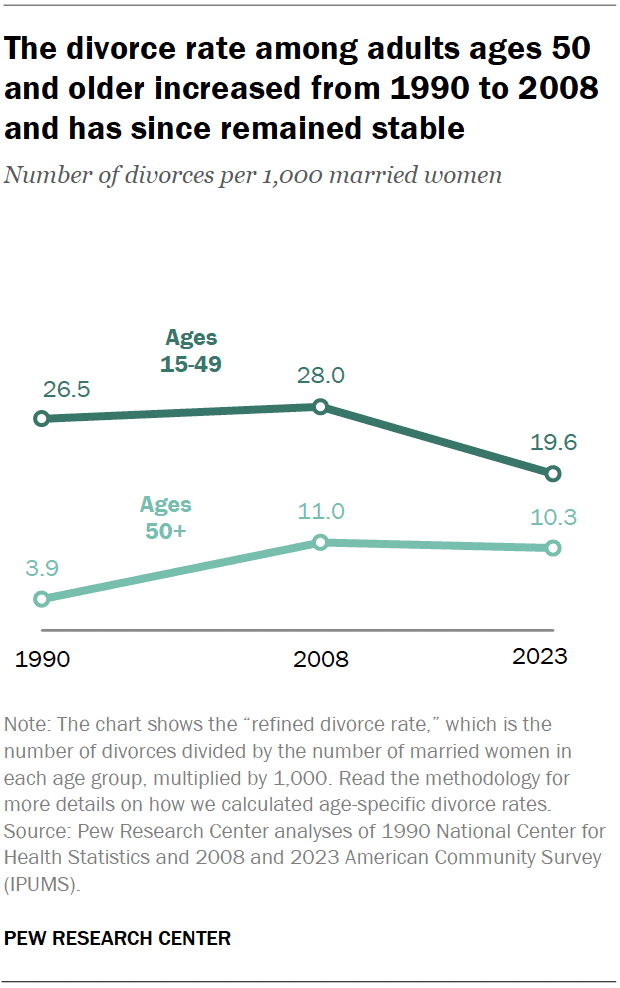
Here's the data that should make us all sit up: In 1990, 1 in 10 divorced people were over 50. Today? It's 1 in 4. We're out here discussing Gen Z's commitment issues while our parents' generation is quietly staging the biggest relationship exit since... well, since they all got married in the first place.
And before you start with the "sanctity of marriage" speeches… save it. A recent UK study systematically reviewed 13,878 people across four countries just found that depressive symptoms spike during the marriage breakdown, when you're still there, still trying, still pretending it works. But after divorce? They normalize. Return to baseline.
Which means it wasn't the divorce destroying people's mental health. It was the marriage.
Read that again.
The marriage was the problem, not the solution.
Women lose an average of $376,000 in wealth post-divorce. Men lose $146,000. That's not a gap; that's a canyon. That's a lifetime of pay inequity, career sacrifices for child-rearing, and pension contributions that vanished into thin air while you were being the "supportive spouse."
But here's the plot twist: Women report higher life satisfaction post-divorce anyway.
Let me say that louder for the people in the back: Women are willing to lose a quarter million dollars more than men and still come out happier on the other side.
Insert the Gray Divorce. The Gray Divorce is when adults over the age of 50 get divorced. While the rates have declined for those 25-39, for those over 50 the increase is sharp.
The truth is, quality of life is tied to who you're partnered with. And if that partnership stopped serving you somewhere between the mortgage and the Medicare, you're allowed to change the terms. Even at 50. Even at 60. Even after 30 years.
Especially after 30 years.
The Financial Gender Gap
Q: Why do women lose more money in gray divorce than men?
A: It's not just about the divorce; it’s about what came before. Women often take career breaks for childcare, work part-time, or support a spouse’s career at the expense of their own. This results in lower lifetime earnings, smaller pensions, and less Social Security. When assets are split, women often divide resources they sacrificed to build. The $376K loss versus men's $146K reflects a lifetime of pay inequity and caregiving penalties.
Q: If women lose more money, why are they happier post-divorce?
A: Because freedom has its own ROI, and the emotional cost of staying was higher than the financial cost of leaving. Many women in these marriages were paying an invisible tax—on their autonomy, identity, and emotional wellbeing. After decades of compromising themselves, $376K can seem like a reasonable price for reclaiming their selves.
Q: How can women protect themselves financially before gray divorce?
A: Know your numbers. Understand marital assets, establish your own credit, consider a financial advisor before making decisions, and if out of the workforce, assess returning options. "Divorce prep" should be as normalized as retirement planning—it's a potential life event that requires strategic thinking.
The Mental Health Paradox
Q: The study shows depression spikes before divorce but normalizes after. Why?
A: Because it’s not the divorce that hurts—it’s the pretending. In the pre-divorce phase, you experience disconnection while still performing the role of "married person." You’re grieving something already dead but pretending it’s alive. Once it’s over, the performance stops, and clarity replaces anxiety.
Q: Does this mean everyone should just divorce if they're unhappy?
A: That's not what the data or I suggest. Staying in a broken marriage "for stability" might create more instability—mentally and emotionally—than leaving would. It's about honest assessment: Is this relationship adding to my life or depleting it? Can it be repaired, or am I avoiding the inevitable?
Q: Why do men turn to alcohol while women use problem-focused coping?
A: We socialize men and women differently around emotional processing and help-seeking. Women build support networks, talk through problems, and seek therapy. Men are taught to "tough it out" and avoid vulnerability. When marriage ends, women activate developed skills, while men often haven’t built those muscles. Emotional resilience is learned behavior, and men deserve to learn it too.
The Time and Agency Factor
Q: Why do childless divorcees recover faster?
A: Fewer entanglements mean faster recalibration. Without adult children creating ongoing connections with an ex-spouse, identity can be rebuilt more quickly.
Q: What's the significance of remarriage improving outcomes?
A: It's about agency and choice. People who remarry aren't happier because they're married again; they're happier because they chose to be. The pattern is clear: self-determination predicts wellbeing. Being married or single matters less than authoring your own life.
Q: How should someone think about the "sunk cost" of a 30-year marriage?
A: Recognize that time invested doesn't obligate you to invest more. Past investment doesn't guarantee future returns in the stock market or relationships. Reframe it: those 30 years were a chapter, and chapters end. Choosing a different future acknowledges that people and needs evolve.
The Longevity Revolution
Q: How does increased life expectancy change the divorce calculation?
A: Dramatically. At 60, expecting to live to 80 means twenty more years, not "twilight"—another complete adult life phase. People reassess: Do I want to spend two more decades like this? When "till death do us part" meant 10-15 years together in old age, the calculation was different. Now it might be three decades. The time horizon changes everything.
Q: Is gray divorce a "trend" or something more fundamental?
A: This is fundamental social restructuring, not a trend. It's driven by increased life expectancy, changing gender roles, economic independence (especially for women), and shifting cultural attitudes about marriage versus self. The rate has gone from 1 in 10 to 1 in 4 in 30 years. That's a revolution.
Q: What should society be doing differently to address this?
A: Stop stigmatizing divorce as failure and treat it as a legitimate life transition requiring support. Develop "divorce prep" financial planning tools, create gender-specific mental health resources, and build community structures not assuming everyone is coupled. Stop organizing society around the assumption that everyone stays married forever, because increasingly, they don't—and won't.
Want to go deeper on the legal and financial landmines of gray divorce?
This is exactly the kind of conversation we're having on Legally Uncensored where we break down the systems, structures, and strategies that actually matter when your life doesn't follow the script.
In our latest season, we're tackling:
The legal loopholes in divorce after 50 that could cost you six figures
Why "equitable distribution" isn't equal—and what you can do about it
The pension division rules nobody explains until it's too late
How to protect yourself financially before you need to
Listen now on Apple Podcasts, Spotify, Youtube, or wherever you get your podcasts.
Because the best time to understand your options is before you need them.