
What Are the Differences Between Divorce Mediation and Litigation?
Mediation vs. Litigation: The Cost and Control Comparison
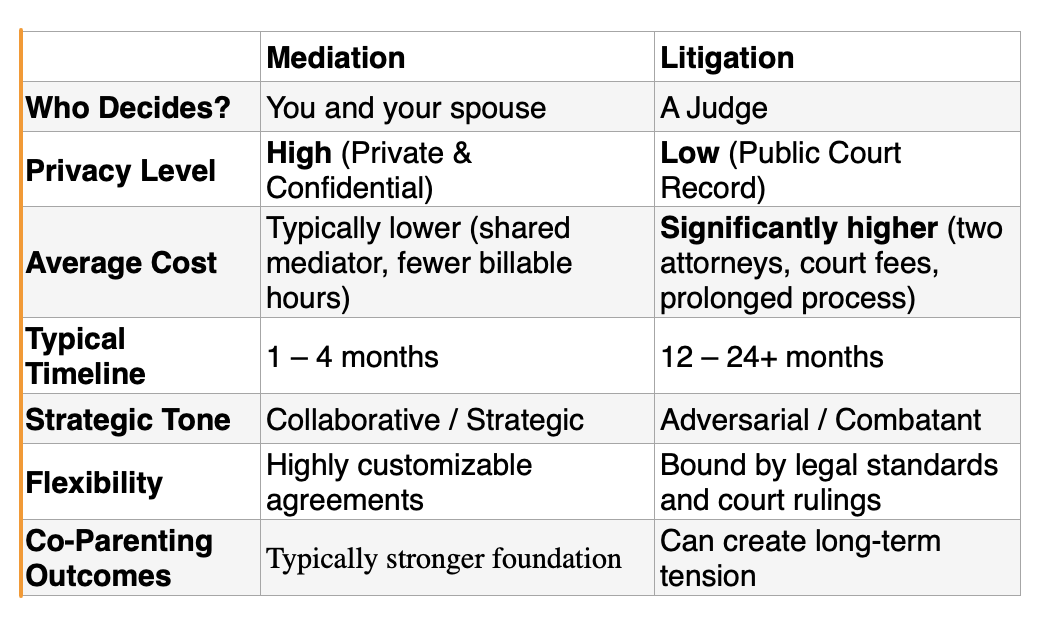
Divorce mediation and litigation differ in cost, control, privacy, and emotional impact. Mediation is collaborative and lower-cost, while litigation involves court decisions and higher conflict. Choosing the right path early can save time, money, and long-term stress for families.
At the beginning of a divorce, most people aren’t asking, “What’s the legal process?”
They’re asking:
“How bad is this going to be?”
The answer often depends on one critical decision: mediation or litigation.
These two paths shape not only your legal outcome but your finances, your stress levels, your co-parenting future, and how long your life feels “on hold.”
What Is Divorce Mediation?
Divorce mediation is a private, collaborative process where both spouses work with a neutral third party (the mediator) to reach agreements on:
Property division
Child custody and parenting plans
Support (child and/or spousal)
The mediator doesn’t make decisions. Instead, they guide conversations and help both sides find common ground.
Think of mediation as:
You + your spouse + a structured conversation = your own agreement
What Is Divorce Litigation?
Litigation is the traditional court-based process. Each spouse hires an attorney, and if agreements can’t be reached, a judge decides the outcome.
This process includes:
Formal filings and court procedures
Discovery (financial disclosures, depositions)
Hearings and possibly a trial
Think of litigation as:
You vs. your spouse + lawyers + a judge = a legally imposed outcome
The Core Difference: Control vs. Surrender
At its core, the difference is simple:
Mediation = You control the outcome
Litigation = A judge controls the outcome
That distinction alone influences everything else—cost, time, emotional toll, and long-term satisfaction.

The "Conscious Uncoupling" Strategy: A Lesson from Gwyneth Paltrow
When Kim Kardashian and Kanye West divorced, their case blended both negotiation and legal escalation. While much of their settlement (like custody arrangements) was negotiated, public disputes and court involvement showed how quickly things can shift toward litigation when cooperation breaks down.
On the other hand, celebrities like Gwyneth Paltrow and Chris Martin famously framed their split as a “conscious uncoupling”. While the internet mocked the phrasing, the strategy was genius. By choosing a private, mediated path, they kept their $200 million fortune out of the tabloid-fueled court system. They mastered the art of accepting the marriage is over and used mediation to transition into a "co-parenting partnership" rather than a legal battlefield.
When Mediation Works Best
Mediation is often a strong choice if:
Both parties are willing to communicate (even imperfectly)
There is a desire to protect children from conflict
Financial situations are relatively transparent
It doesn’t require you to be friends.
When Litigation May Be Necessary
Litigation becomes more likely—or necessary—when:
There is high conflict or power imbalance
One party is hiding assets or refusing disclosure
There are concerns about abuse or safety
Negotiations repeatedly fail
In these cases, court intervention provides structure and enforcement that mediation cannot.
Choosing mediation doesn’t lock you out of litigation.
But choosing litigation often makes mediation much harder later.
The path you choose depends on your circumstances but understanding the difference early can mean the difference between rebuilding your life strategically or recovering from unnecessary damage later.
If you’re trying to make sense of your next move, and you're tired of the "figure it out" strategy costing you your peace, come hang out with us at the Legally Uncensored Podcast. We’re obsessed with giving you the first principles you need to navigate these transitions. 🎧✨